Finding a leak doesn’t automatically mean it’s time for a new roof.
At Vanguard Roofing, we’ve inspected buildings where a simple repair solved the problem for years. We’ve also seen owners spend thousands on patching the same roof over and over when a replacement would have been the better investment from the start.
The challenge is knowing the difference.
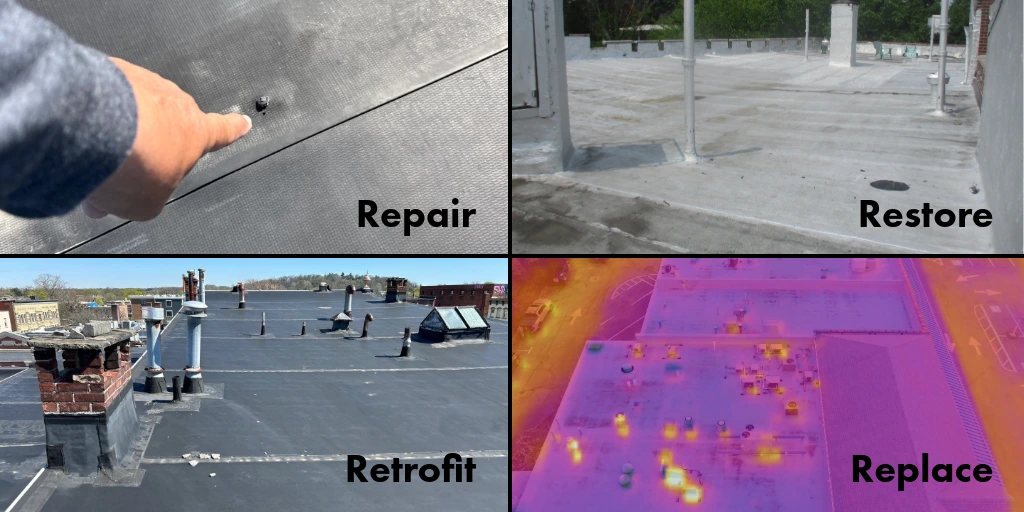
If your commercial roof is leaking—or if you’re dealing with recurring repairs, aging roofing materials, or a roof that’s nearing the end of its life—you generally have four options:
- Patch the leak
- Restore the roof
- Retrofit the roof
- Replace the roof
The right choice depends on the condition of the roof, how much damage exists below the surface, and how long you need the roof to perform.
Before spending money on repairs, it’s important to understand what each option accomplishes and when it makes sense.
A Quick Comparison of Your Options
| Repair | Varies | 3–10 Years | Isolated damage |
| Restoration | $5–$8/SF | 10–15 Years | Aging but serviceable roofs |
| Retrofit | $8–$15/SF | 20+ Years | Structurally sound roofs needing an upgrade |
| Replacement | $18–$25/SF | 20–30+ Years | Roofs at the end of their useful life |
These ranges are intended for budgeting purposes only and do not include labor, equipment, tear-off, disposal, transportation, permits, or other project-specific costs.
First Things First: What Condition Is Your Roof Actually In?
Most roof decisions start with one simple question:
Is the problem isolated, or is the roof system failing?
A newer roof with one leak is usually very different from a 20-year-old roof with multiple leaks, wet insulation, and a history of repairs.
That’s why a proper inspection matters.
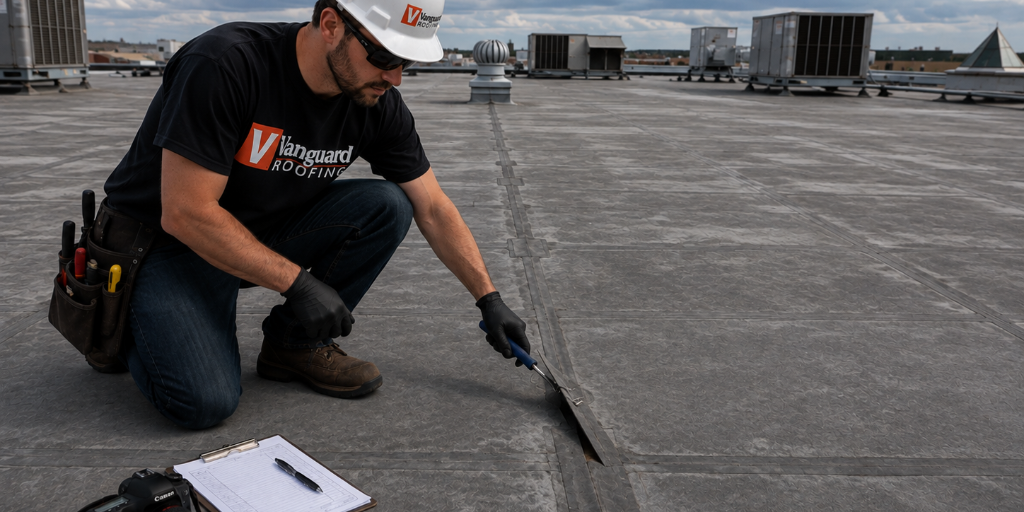
A commercial roof inspection should determine:
- Where the leak is coming from
- Whether the damage is isolated or widespread
- Whether insulation has become saturated
- How much useful life remains
- Which option makes the most financial sense
Without that information, it’s easy to spend money solving the wrong problem.
Option 1: Patch the Leak
If the damage is limited to one area, a repair may be all that’s needed.
A patch repair addresses a specific problem, such as:
- A puncture in the membrane
- A failed seam
- Damaged flashing
- A small area of storm damage
When the surrounding roof is still in good condition, a repair can be the fastest and most cost-effective solution.
When a Repair Makes Sense
A repair is usually the right choice when:
- The roof is relatively new
- The leak is isolated
- The surrounding membrane is still in good condition
- There is no widespread moisture beneath the roof
- The same area has not been repaired repeatedly
A properly performed repair can often provide several additional years of service life.
When Repairs Stop Making Sense
Anyone can stop a leak for today.
The bigger question is whether you’re fixing the problem or simply postponing it.
If leaks keep appearing in new locations or the same area continues to fail, the issue may no longer be localized. At that point, continued repairs may become more expensive than looking at the roof system itself.
Option 2: Restore the Roof
Roof restoration sits between repairs and replacement.
Instead of removing the existing roof, a restoration system is applied over the current membrane. The roof is cleaned, repaired where necessary, reinforced around seams and penetrations, and then coated with a protective roofing system.
Think of restoration as extending the life of a roof that still has good bones.
When Restoration Makes Sense
Restoration can be a smart investment when:
- The roof is aging but still structurally sound
- The roof deck is dry
- Insulation is not saturated
- Leaks are minor and manageable
- The membrane is aged but still functional
When performed at the right time, restoration can often add 10 to 15 years of service life while not having the expense of replacement.
When Restoration Is Not Enough
Restoration is not a solution for a failing roof.
If moisture has spread throughout the insulation, structural components are damaged, or the membrane has reached the end of its life, applying a coating may simply delay the inevitable.
Timing matters. Restoration works best before major deterioration occurs.
Why Wet Insulation Changes Everything
One of the most important factors in any roof evaluation is whether insulation has become wet.
Many building owners are surprised to learn that water doesn’t always stay where the leak appears inside the building. Moisture can travel through insulation and spread well beyond the initial entry point.
Wet insulation:
- Loses much of its insulating value
- Can increase heating and cooling costs
- May hide widespread moisture damage
- Often requires removal during future roofing project
This is why moisture scans and roof testing are often recommended before deciding between restoration, retrofit, or replacement.
Option 3: Retrofit the Roof
A retrofit involves installing a new roofing system over the existing roof rather than removing everything down to the deck.
In many cases, new insulation is installed first, followed by a new membrane.
For building owners, a retrofit often provides many of the benefits of a new roof without the disruption of a full tear-off.
When a Retrofit Makes Sense
A retrofit may be the right solution when:
- The existing roof insulation is dry
- The roof deck is structurally sound
- Energy efficiency needs improvement
- Drainage problems need correction.
- The building will stay open during construction
- The owner wants long-term performance without a complete tear-off
Why Choose a Retrofit Instead of Replacement?
This is the question many owners ask.
The answer usually comes down to the condition of the existing roof.
If the roof deck and insulation are still performing and building codes allow it, a retrofit can provide:
- Lower disposal costs
- Less interference to operations
- Faster installation
- Improve insulation values
- Better drainage through tapered insulation
- A completely new roofing system
For many facilities, it offers an attractive trade-off between cost, performance, and disruption.
When a Retrofit Is Not Recommended
A retrofit is generally not a good option when:
- Insulation is wet
- The roof deck is damaged
- Structural issues exist
- Building codes limit additional roof layers
- Significant moisture is trapped within the system
In those situations, a full tear-off is often the smarter long-term investment.
Option 4: Replace the Roof
Eventually, every roof reaches a point where roof replacement becomes the most economical option.
Replacement involves removing the existing roof system, inspecting the deck, replacing damaged materials, installing new insulation, and installing a new roofing membrane.
While replacement has the highest upfront cost, it also provides the longest service life.
Signs It May Be Time for Replacement
Consider replacement if:
- The roof is approaching 20 to 30 years old
- Leaks occur in multiple areas
- Repairs have become frequent
- Insulation is saturated
- The membrane is failing
- Structural concerns are present
- Repair costs continue to climb
Age alone doesn’t determine whether a roof needs replacement, but age combined with recurring problems is often a strong indicator.
What Does Commercial Roof Leak Repair Cost?
Costs vary based on the roofing system, building size, accessibility, existing conditions, and the scope of work.
For budgeting purposes, most commercial roofing projects fall into the following ranges:
| Roof Restoration | $5–$8 per square foot |
| Roof Retrofit | $8–$15 per square foot |
| New Roof Replacement | $18–$25 per square foot |
These ranges are intended as budgeting guidelines only.
They do not include labor, equipment, tear-off, disposal, transportation to and from the job site, permits, project setup, or other site-specific costs that can affect final pricing.
The most accurate way to determine cost is from a professional roof inspection and site-specific estimate.
So, Which Option Is Right for Your Roof?
The answer depends on what is happening below the surface.
A leak doesn’t automatically require a replacement. At the same time, not every roof can be saved with a repair or restoration.
The most cost-effective decision starts with understanding the condition of the roof, the amount of moisture present, and the remaining service life of the system.
That’s where an experienced commercial roofing contractor can help.
Schedule a Commercial Roof Inspection
If your roof is leaking, don’t guess.
A professional inspection can identify the source of the problem, determine whether moisture has spread beneath the roofing membrane, and help you understand whether repair, restoration, retrofit, or replacement makes the most financial sense.
At Vanguard Roofing, we help building owners make educated decisions based on the condition of the roof—not a one-size-fits-all recommendation.
Contact Vanguard Roofing today to schedule an inspection and receive a roof assessment customized to your building.